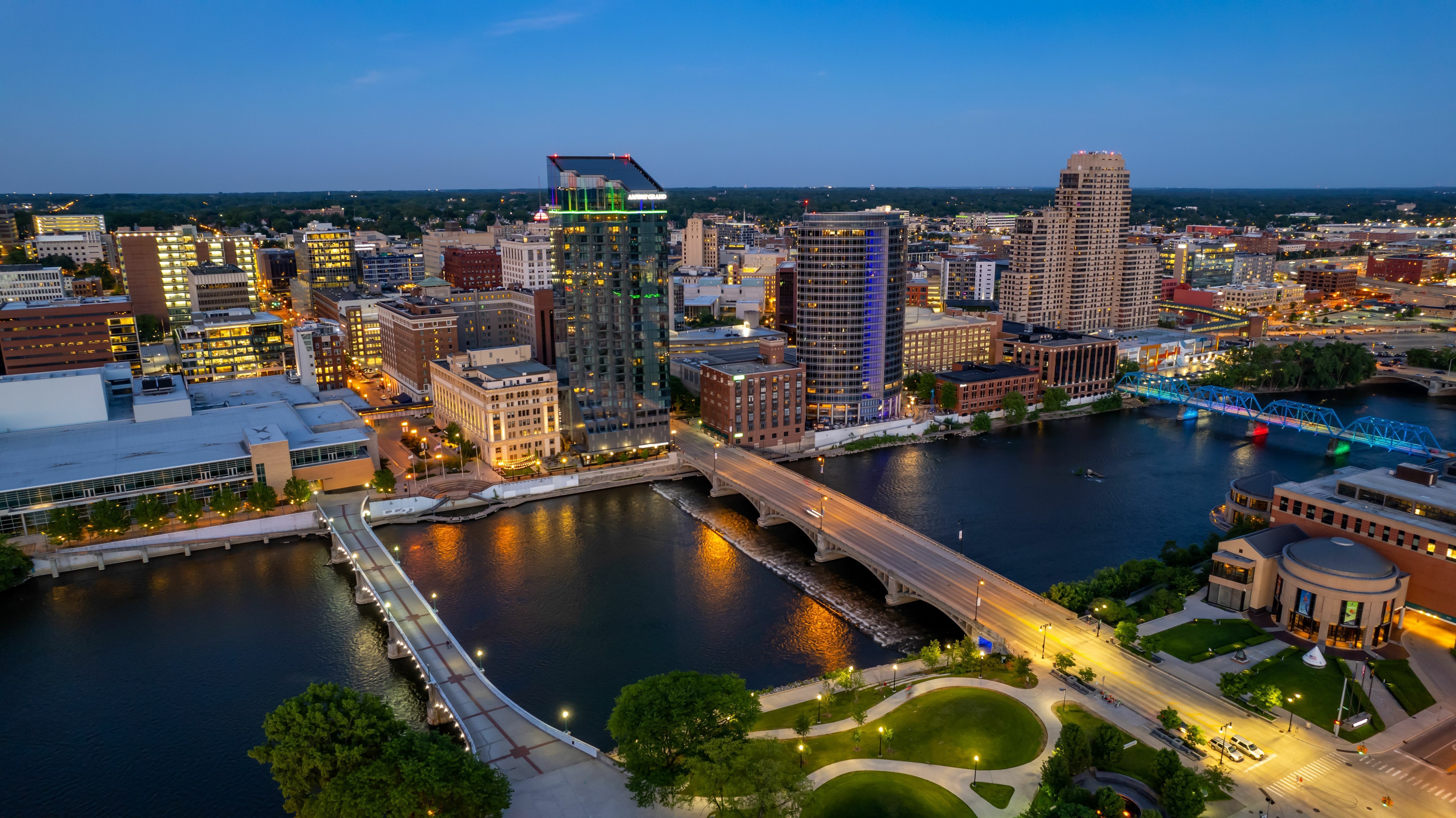
Many of the country’s regional economic success stories hinge on economic development organizations like The Right Place in the Greater Grand Rapids area of West Michigan. The Right Place serves this region by supporting businesses located there: connecting them with local talent in the workforce, integrating them into the local supply chains, securing government incentives, and more.
The Reimagining the Economy project spoke with Birgit Klohs, who worked as President and CEO of The Right Place for over 30 years. She discussed how the region has changed over those years and the role her organization played in this process. You can listen to the conversation as a podcast.
Klohs touched on a number of topics which can be explored more deeply on this platform.
Looking back, seeing growth
She began by explaining the dismal economic context in 1983, when the group which would become The Right Place first convened.
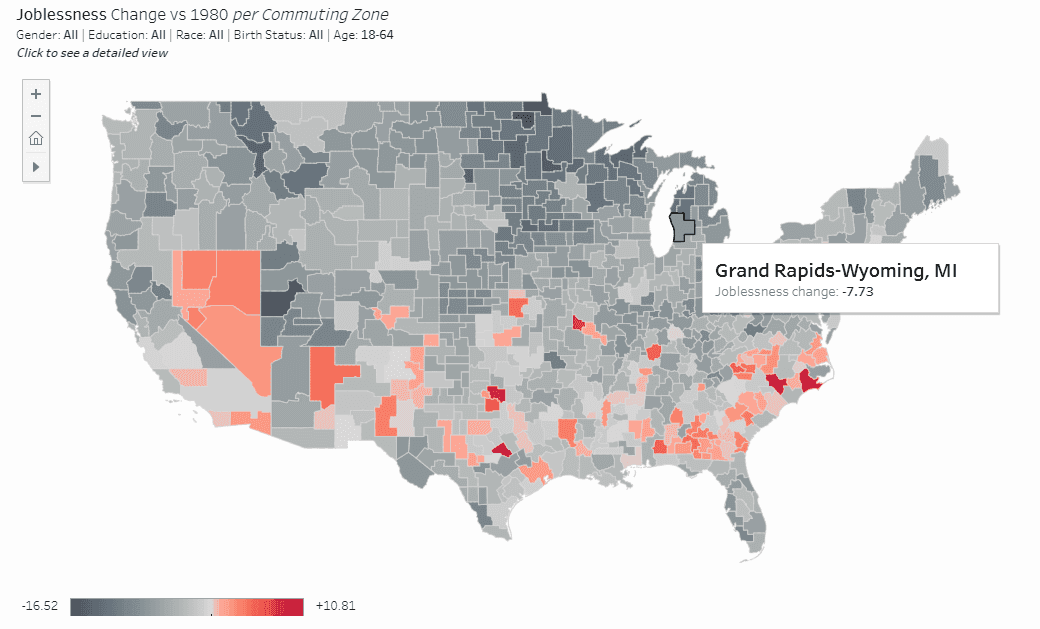
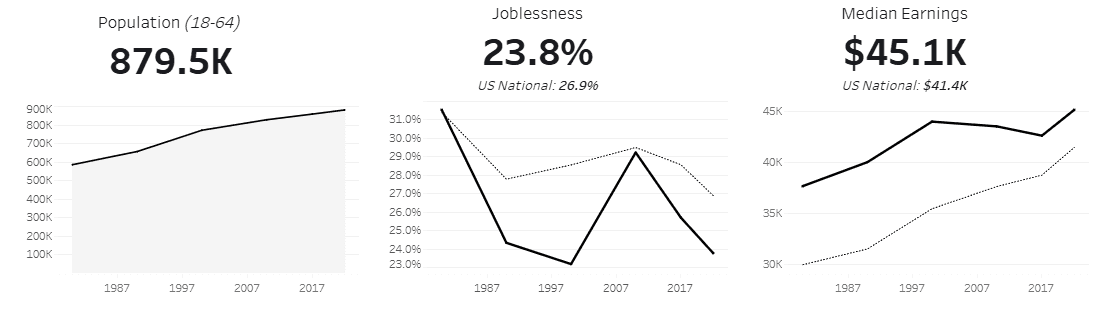
In the data, you can see that joblessness is lower now than it was in 1980 in most of the country — including in the Grand Rapids-Wyoming commuting zone, where The Right Place operates.
Since then, the area’s population and income have grown, while joblessness has shrunk — in part due to The Right Place’s efforts to attract new businesses and, especially, to support existing businesses.
Local specialization
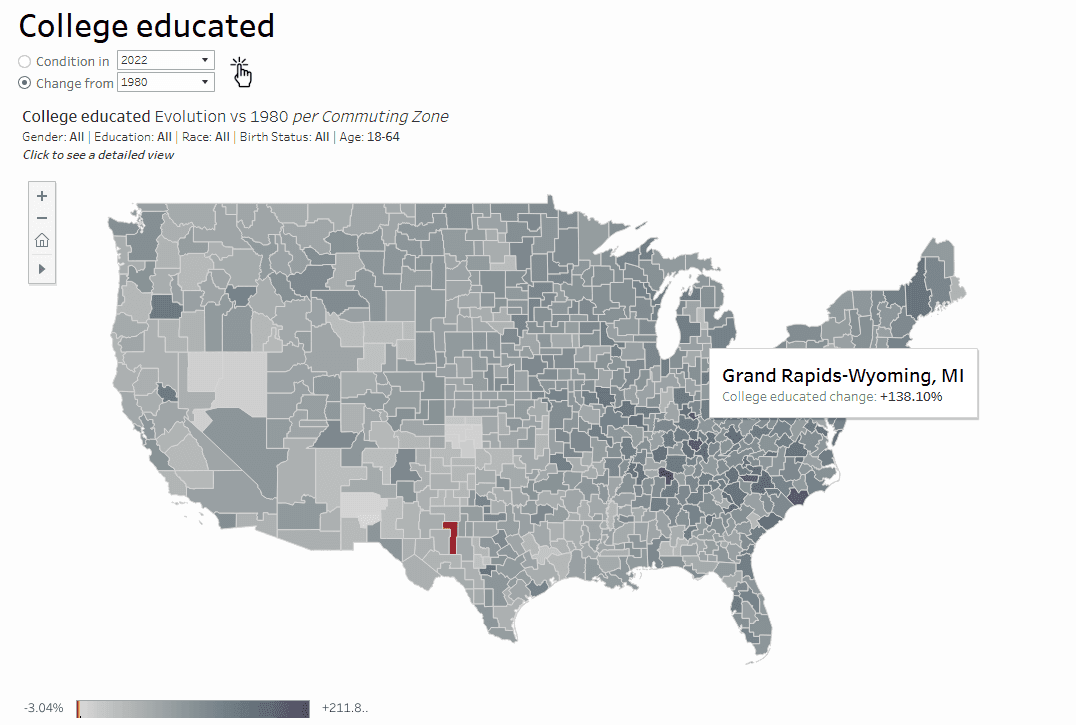
According to Klohs, one of their biggest successes has been the coordinated efforts and investments to create the “Medical Mile”: a hub for medical care and life sciences research. Investments in the Medical Mile and elsewhere have created more than 100,000 health sciences jobs in West Michigan. This, along with a number of efforts to attract, develop, and retain skilled workers, has drawn a large college-educated population to the area. Since 1980, the number of college-educated people in the area has grown by over 138% — above the national average of 117% growth.
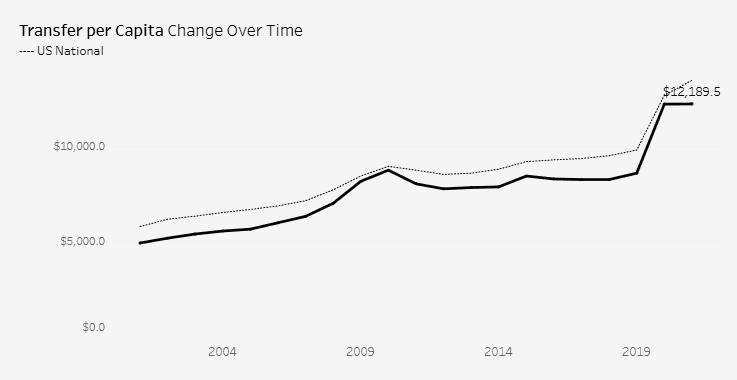
Klohs emphasized the role of private investment and philanthropy in the region’s development. For the last decades, private money has made a huge difference. Research from a local university finds that Grand Rapids “flourished beneath the partnership of individual philanthropy and ‘place-rooted’ foundations.” Local, state, and federal governments have also contributed, but our data show that Grand Rapids-Wyoming has received less federal public money per capita than the average commuting zone.
Inequality
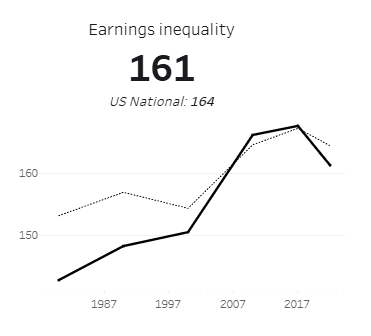
Along with the region’s economic growth, there has been growth in inequality. Earnings inequality in the entire region has gone from well below the national average to about the same as the national average. The Economic Policy Institute uses the ratio between top 1% earnings and bottom 1% earnings to measure income inequality within a city: by this measure, the city of Grand Rapids has the highest income inequality in the state of Michigan, and is in the top 100 most unequal cities in the country.
Part of The Right Place’s mission is to achieve shared prosperity: an equitable regional economy. So, they have taken a number of steps to address income inequality, for example coordinating with workforce development programs to make good jobs available to people without 4-year college degrees.
The other major inequity is along racial lines. In 2015, Forbes combined data on homeownership, self-employment (a proxy for entrepreneurship), and median household income of Black Americans, and found that Grand Rapids is the second-worst city in the country according to these metrics.
Looking at the data on this platform, you can see how racial inequality in the Grand Rapids-Wyoming commuting zone is bad and has gotten worse over time. White residents of the Grand Rapids-Wyoming commuting zone have higher earnings and lower joblessness than the white national average, but non-white residents have the same earnings and joblessness as the non-white national average. The national white-non-white average earnings gap is $8,600. In Grand Rapids-Wyoming, the gap is $12,900.
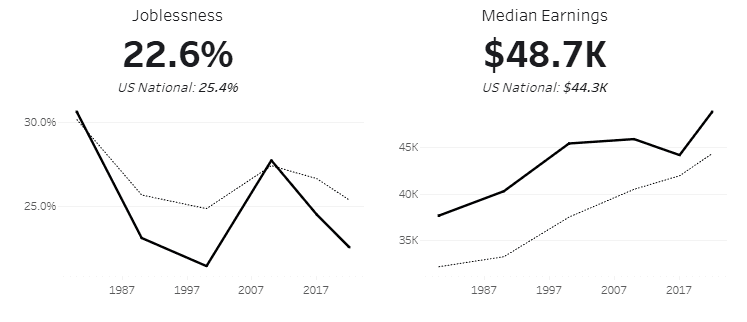 Joblessness and earnings for white residents of Grand Rapids-Wyoming.
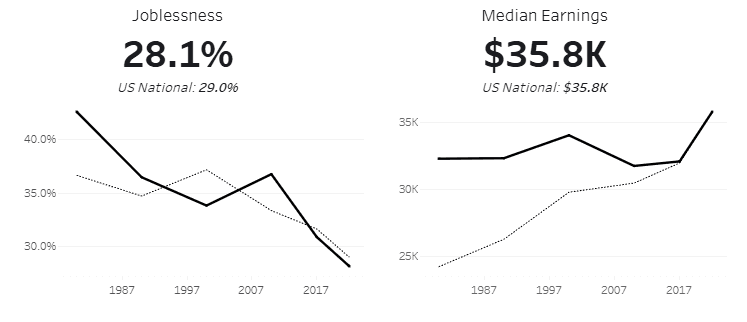 Joblessness and earnings for non-white residents of Grand Rapids-Wyoming.
The city of Grand Rapids and the state of Michigan are working hard to address this problem — even declaring racism a public health crisis.
Klohs is taking action, too. She created and leads a venture capital fund specifically for communities of color called the New Community Transformation Fund. She is hopeful that the fund will diversify business leadership in the region and that the region will continue to grow.