As part of the so-called "Rust Belt," Rochester, New York endured difficult economic losses as America deindustrialized. However, the city has bounced back in recent years as a result of combined efforts to update and grow the local economy. Part of this work was done by local public, private, and public-private organizations, like the Greater Rochester Enterprise (GRE), an economic development agency that works in and around Rochester to connect businesses with local resources and workers so they can establish and grow in the area.
The Reimagining the Economy project spoke with Matt Hurlbutt, President and CEO of GRE. Hurlbutt describes GRE’s role as a ‘concierge,’ helping local business leaders to solve problems today and plan for the future. You can listen to the full conversation as a podcast.
Hurlbutt discussed topics and policy interventions in Rochester which can be examined in more detail on this platform.
Local support for small firms
GRE primarily supports small- and medium-sized enterprises (with 10-99 employees) along with a few big-ticket investments. Hurlbutt said that job growth in the region has been driven by ‘second stage’ companies (with revenues between $1 million and $50 million), with 230 such firms being supported by the GRE and the National Center for Economic Gardening. According to Hurlbutt, this collaboration has generated nearly 2,000 jobs and increased local firms’ revenue by around $500 million.
On this platform, Rochester falls within the Buffalo-Cheektowaga-Tonawanda commuting zone. On the Economic Conditions dashboard, you can see that joblessness in the region has fallen significantly since 1990 and is slightly below the national average, and median earnings have been consistently at or above the national average.
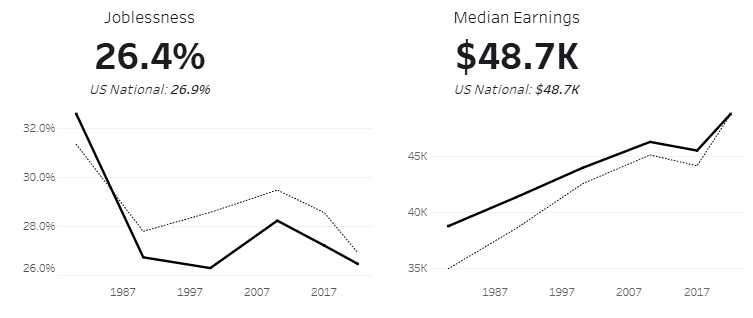
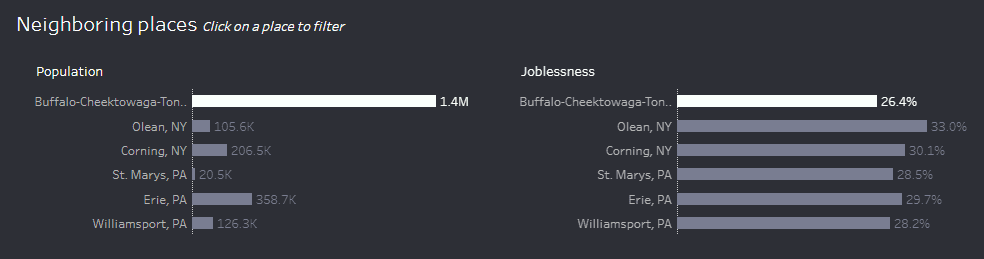
The low joblessness and high earnings compare well with the rest of Upstate New York. Hurlbutt points to firms, including in software and food and beverages, expanding their footprint outside Rochester as crucial to this success.
Optics and education
The Rochester area specializes in imaging optics. Xerox, Bausch & Lomb and (Eastman) Kodak are all headquartered in Rochester, and their expertise and operations have helped to drive much of the region’s economy for many years. 19,000 people across about 120 companies work in optics in Rochester today.
This is a high-tech industry which receives support from coordinated efforts by state and local development agencies, policymakers, interest groups, firms, and schools. GRE in particular ties companies with the local education system so they have access to capable workers. To keep the industry up-to-date as markets and technology evolve, GRE and others connect large market leaders with smaller, growing optics companies in areas such as 3D imaging and medical laser technology, allowing them to share ideas and workers.
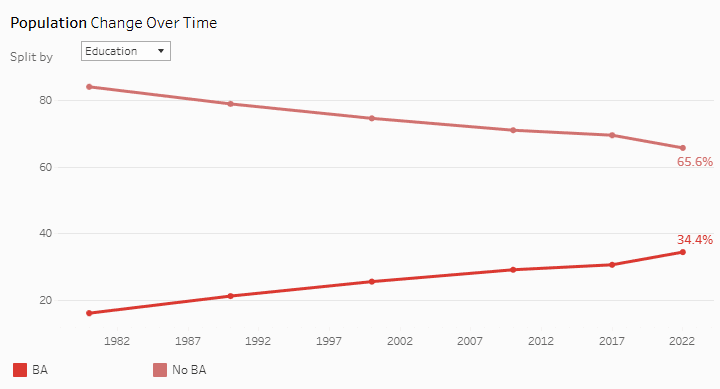
GRE specifically targets the talent pipeline for optics firms through its work with the University of Rochester (which confers around 50% of optics degrees nationally) and local community colleges. For example, GRE partners with Monroe Community College, which runs a highly specialized two-year program producing precision optical technicians. Hurlbutt’s team keeps these education partners informed as local firms set expansion plans in an effort to match labor supply and demand. The local area has seen its proportion of university graduates rise considerably since 1980.
Prior to joining GRE, Hurlbutt’s experience was in workforce development. Workforce development programs keep people informed on which jobs are in demand and helps train them in preparation for those jobs.
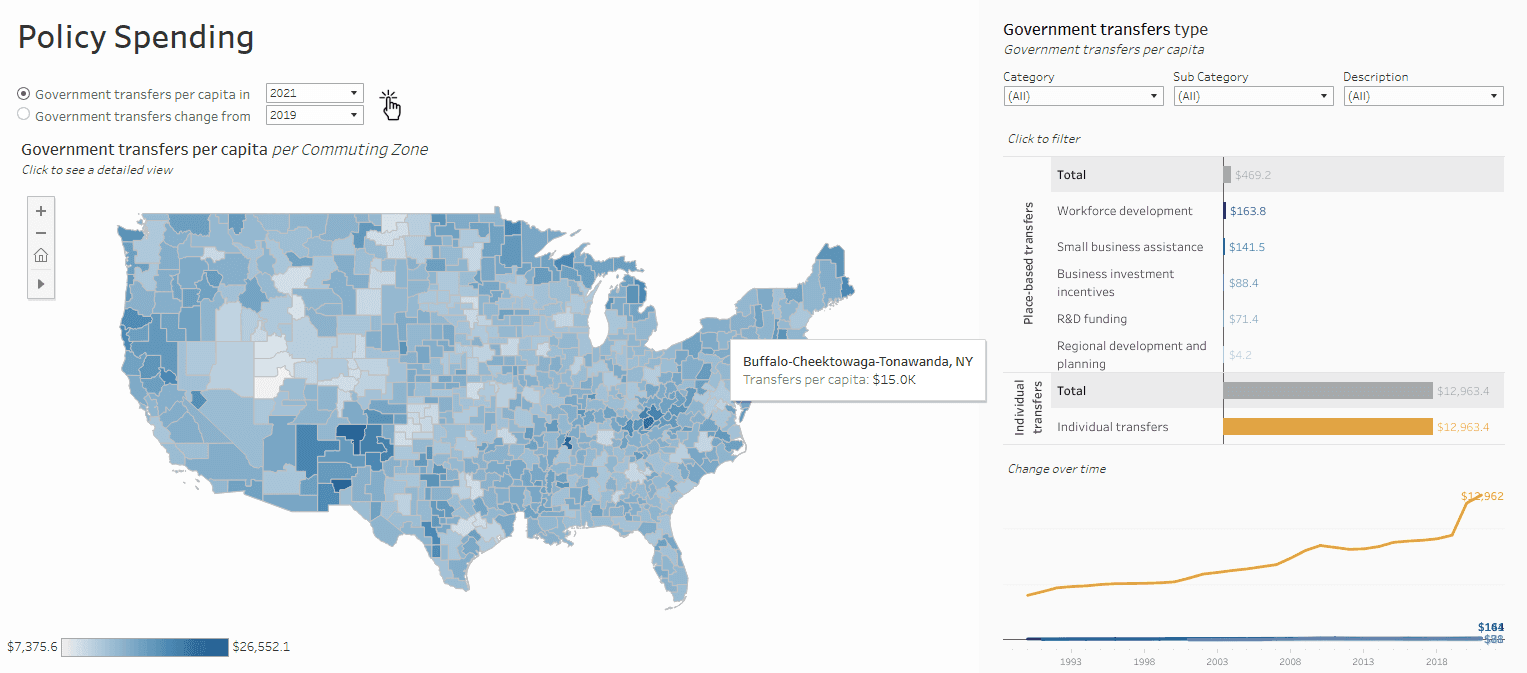
The platform allows users to compare different place-based transfers, including workforce development, across time in the US. While workforce development spending is growing, it remains a very small fraction of federal and local spending compared to individual transfers in Rochester and around the country.
As Rochester and the wider Buffalo-Cheektowaga-Tonawanda area continue to build back after deindustrialization, GRE and others are showing how targeted intervention and coordinated workforce development programs can help play to regions’ strengths and create good jobs.