In August 2024, the City of Birmingham, Alabama was awarded a $20 million grant from the Economic Development Administration (EDA) as part of the Recompete Pilot Program. The novel program targeted distressed communities across the country that face high prime-age unemployment and provided strategy development grants to a group of finalists.
Birmingham's economic distress can be explored through data from the Economy in Place. The data on the platform are at the commuting zone level, but for this post we used our data to more precisely cover the Birmingham, AL region that received Recompete funding.
A slow recession recovery
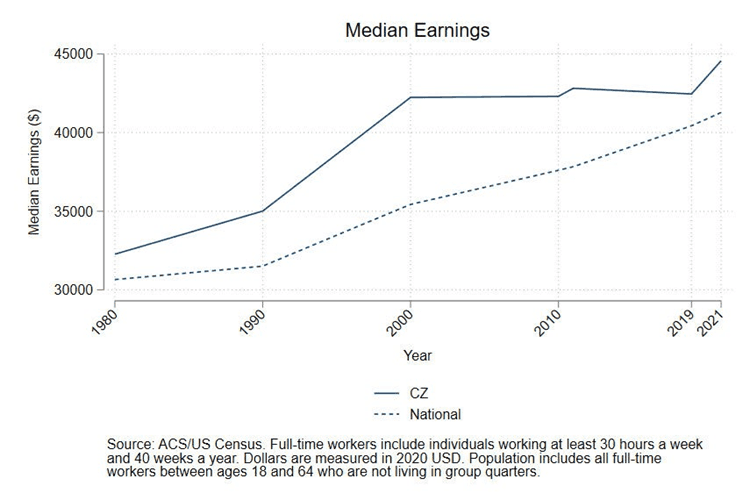
Diving into the data, we see that while median earnings have been higher than the national average (as is typical for urban areas), growth has been stagnant for the past two decades. Looking at earnings inequality data helps explain this finding. Birmingham has had a significantly higher earnings inequality rate than the national average, and the gap has widened since the Great Recession. Higher inequality is generally linked with stagnant median earnings because it means that only top earners are experiencing wage growth.
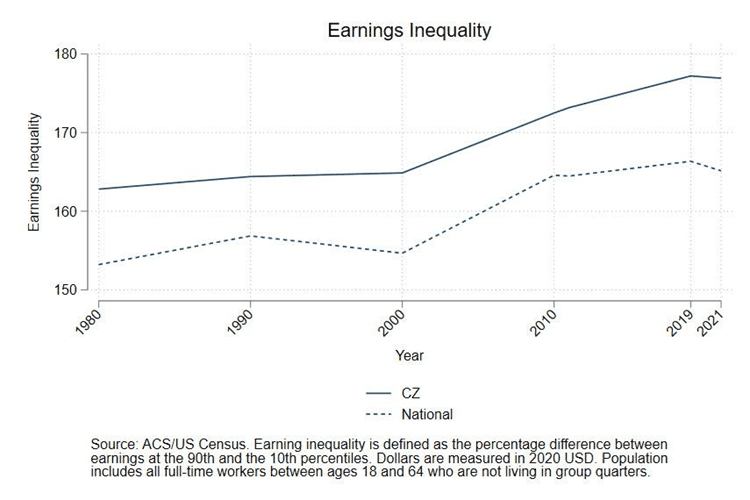
Much of this inequality can be explained by Birmingham’s exceptionally slow recession recovery. A Brookings Institution study found the city to be an outlier among most major metro areas in terms of the length of time it took to recover and the increase in relative poverty that followed. Also contributing to earnings inequality is that Birmingham, despite being a majority Black city, has one of the lowest rates of Black business ownership. Given this context, Birmingham's Recompete proposal aims to move the needle on earnings inequality and increase earnings, by establishing a Black Business Entrepreneurship Center to expand support for Black-owned businesses and accelerate their growth.
Diving into joblessness
Another challenge for Birmingham is visible in its high level of joblessness. Looking at joblessness enables economic development practitioners to see how big their region's productivity shortfall is in underutilized workers, so they can act to identify and eliminate barriers to labor force participation.
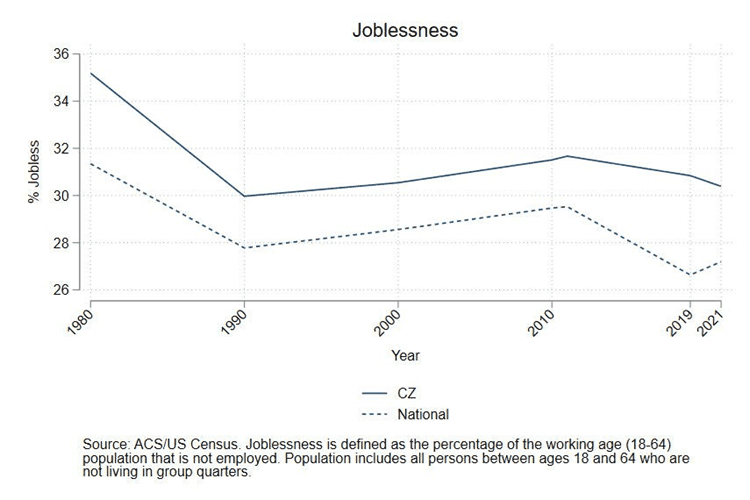
That’s exactly what the architects of Birmingham’s Recompete Plan did. Our data show that Birmingham has had a substantially higher joblessness rate than the national average since 1980. The Recompete team recognized that when joblessness is high, traditional workforce development interventions that focus on training and outreach are not enough. Policy must also act to eliminate the specific barriers that are inhibiting employment. In Birmingham's case, these are access to transportation and childcare.
A 2021 report from the Center for Transportation Studies at the University of Minnesota found that Birmingham ranked last out of 50 major U.S. metropolitan areas on transit accessibility of jobs, meaning that most jobs had commuting times of greater than 30 minutes by public transit or walking for the typical worker. To address this barrier, Birmingham's Recompete plan includes a "Connect Birmingham" initiative, which uses microtransit to expand its available bus routes in communities experiencing the highest rates of joblessness.
Research from the Women’s Foundation of Alabama found that the state's childcare supply is extremely constrained. 65% of children under five live in households with both parents working or a working single parent, but there are only seats available in the state for 36% of these children. Our data show that joblessness for women is 10% higher than for men in Birmingham, which research has linked to the low availability and affordability of childcare. Birmingham’s Recompete plan tackles this barrier by establishing a "Child Care Center of Excellence," which will train more childcare workers and entrepreneurs and increase the availability of childcare subsidies.
A new type of policy transfer
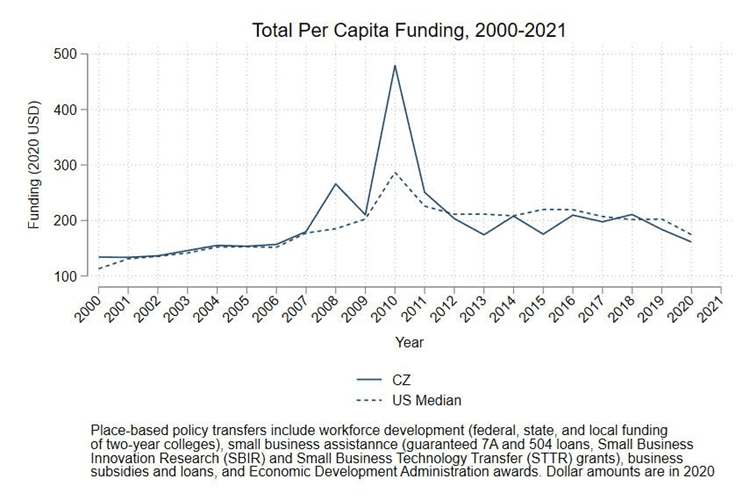
Birmingham’s struggle to overcome the recession’s impact comes in spite of the region receiving significantly more per-capita federal economic development policy transfers in its wake than the average commuting zone. Our data show the amount of placed-based policy transfers for workforce development, small business assistance, business subsidies and loans, and Economic Development Administration awards.
The novel design and focus of the Recompete Pilot program and its focus on holistically reducing joblessness has presented the city with a game-changing opportunity to finally move the needle on this long standing challenge. Our data can help practitioners continue to follow their progress.